Sandra Beldine Otieno
May 16, 2024
Share article


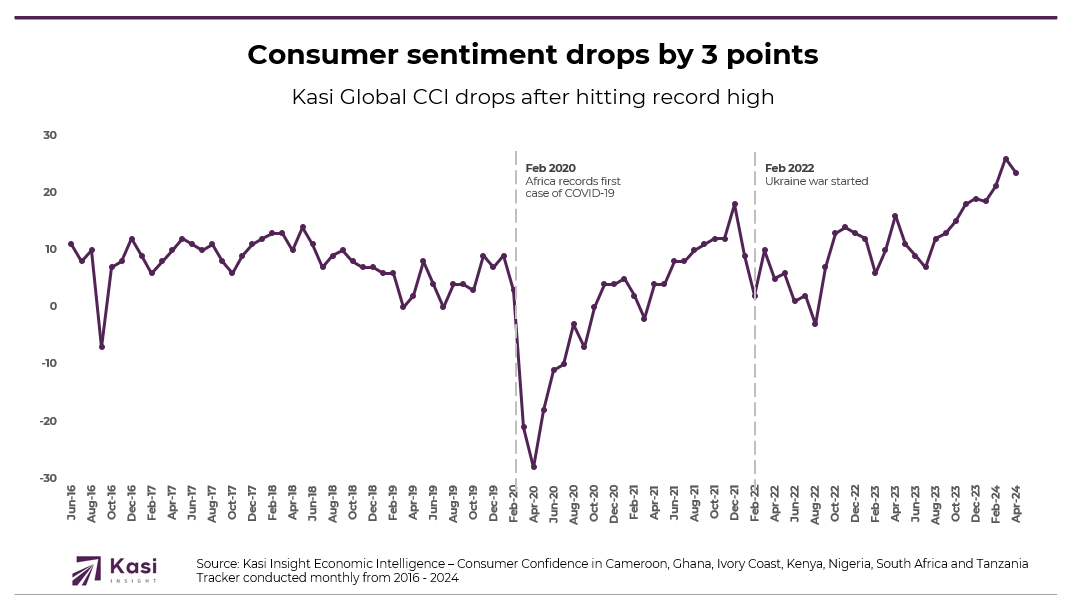
In April, consumer confidence in Africa reversed its upward momentum, declining by three points after five months of growth. This downturn brought the index down from its recent highs, influenced by a seven-point increase in the index of current conditions and a one-point decrease in the index of future expectations, reflecting a mixed outlook among households.
In April, Africa experienced a downturn in household indices compared to the previous month, marking a departure from previous improvements. The only exception was household income, which saw a slight increase of one point, indicating a marginal improvement amidst broader declines.
Specifically, the personal finance index dropped by one point, suggesting a slight deterioration in individuals' perceptions of their financial situations. This decrease reflects emerging pressures that could impact financial resilience. Meanwhile, household spending decreased by three points, indicating a more cautious approach to expenditure due to economic uncertainties or diminished disposable income for non-essential items.
Discretionary spending saw a significant reduction, plummeting by nine points. This substantial decrease highlights a tightening in household budgets, with a clear prioritization of essential spending as economic pressures mount. The job prospects index also fell by four points, underscoring growing concerns about the availability and stability of employment, possibly influenced by a cooling economic climate or shifts in the labor market.
Moreover, the indexes that measure the general economic conditions in the country and city also saw declines, dropping by one and two points respectively. These declines suggest a tempering of economic optimism and a cautious outlook on the overall economic landscape, reflecting a broader apprehension about future economic conditions.
In Nigeria, consumer sentiment improved by four points. This improvement was driven by a 14-point surge in the index of household spending, an 11-point increase in the index of household income, and a 7-point rise in the index of future expectations. This positive sentiment is partly due to the International Monetary Fund's (IMF) forecast projecting Nigeria will become the fourth-largest economy in Africa by the end of the year, trailing South Africa, Egypt, and Algeria. Although Nigeria has held the title of Africa’s largest economy since the GDP rebasing in 2013, the IMF now projects its total GDP for 2024 to be $253 billion, influenced primarily by the devaluation of the Naira. The prospect of economic growth, despite the GDP decrease, has boosted consumer confidence.
Conversely, Tanzania experienced a 16-point decline in consumer sentiment. This decline is attributed to a 24-point drop in the index of current conditions, a 20-point drop in the index of country economic conditions, and a 12-point drop in the index of future expectations. The negative sentiment aligns with the severe flooding caused by heavy rainfall. Coastal regions of Tanzania were the most affected, with at least 58 fatalities and thousands more impacted. The country typically experiences increased rainfall during its main rainy season from April to May, but the 2024 season has been amplified by the naturally occurring El Niño phenomenon, leading to more severe flooding. The ongoing heavy rainfall and subsequent flooding have disrupted lives, contributed to economic instability, and significantly lowered consumer confidence.
For brands operating in Africa, the decline in consumer confidence and the downturn in household indices in April signal several important considerations. With consumer confidence declining, especially in terms of current conditions and future expectations, brands may need to adjust their marketing strategies to address the cautious sentiment. Emphasizing value for money, essential benefits, and affordability can resonate more with consumers during this period. The significant drop in discretionary spending indicates that consumers are prioritizing essential items over non-essential ones. Brands should focus on promoting essential products and consider offering promotions or discounts to encourage spending in this category.
The drop in household spending and personal finance indices suggests that consumers are feeling the pinch of economic pressures. Brands may need to adapt their product offerings and pricing strategies to align with the reduced disposable income and financial resilience of their target market. While consumer sentiment declined in countries like Ivory Coast, South Africa, and Tanzania, it improved in Cameroon, Ghana, Kenya, and Nigeria. Brands should leverage the positive sentiment in these countries by intensifying their marketing efforts and capitalizing on the favorable consumer outlook.
The decline in the job prospects index indicates growing concerns about employment stability. Brands may want to closely monitor employment trends and adjust their workforce strategies, accordingly, possibly offering job security and incentives to retain talent. The declines in the indexes measuring general economic conditions suggest a cautious economic outlook. Brands should prepare for potential economic uncertainties by maintaining flexibility in their operations and being ready to pivot strategies as needed. To counteract the decline in consumer confidence, brands can invest in initiatives that build trust and confidence among consumers, such as transparent communication, corporate social responsibility activities, and community engagement efforts.
Share on socials using this caption: : 📉 In April, Africa's consumer confidence dropped by 3 points, ending a 5-month rise. Economic pressures are reshaping spending habits and financial outlooks across the continent. 💸📊 #AfricaEconomy #ConsumerTrends #EconomicUpdate
2409 views
Share article
Trust Is Becoming Economic Infrastructure
Consumer confidence loses momentum in October
Confidence plateaus in September as caution defines household behavior