Paul Cheloti Mulongo
May 30, 2025
Share article



Kasi Insight’s Sustainability Tracker sheds light on how Nigerians across generations are responding to the growing climate crisis. This annual tracker, conducted in multiple African markets, explores evolving consumer attitudes toward environmental issues. It examine not only what people know but also how deeply they care, and what they expect from businesses and institutions in supporting sustainable development.
Overall, climate awareness in Nigeria is strong. About 64% of Nigerians say they are knowledgeable about environmental issues such as climate change. Among the generations, Gen Z leads slightly at 68%, followed by Millennials at 64% and Gen X at 63%. However, these figures mask important variations in certainty and depth of understanding.
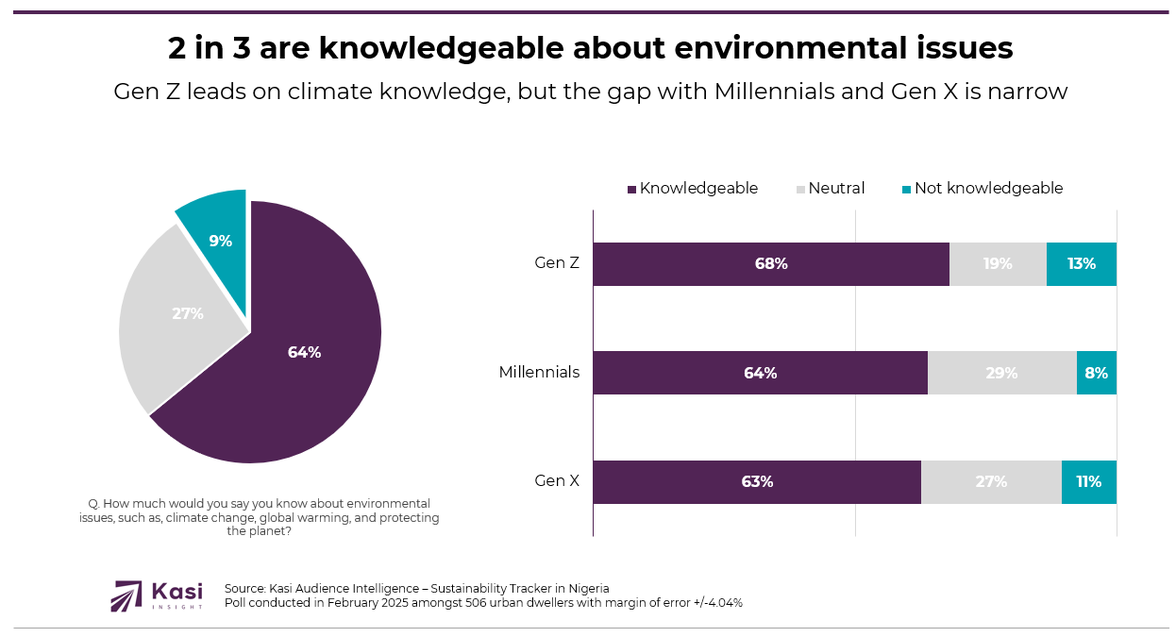
Gen X shows more uncertainty than other generations, with 27% saying they feel neutral about their level of knowledge and another 11% stating they are not knowledgeable. This suggests that Gen X could benefit from more targeted, contextual education that builds confidence in environmental topics. Gen Z presents a different paradox: while they report the highest knowledge levels, they also have the largest share saying they are not knowledgeable at 13%. This polarized distribution indicates that Gen Z contains both highly informed individuals and others who remain detached from climate discourse.
While awareness levels are relatively high, emotional concern about climate change is more uneven. Millennials emerge as the most engaged generation, with 80% expressing concern about climate change. Gen X follows closely at 78%, mirroring the national average.
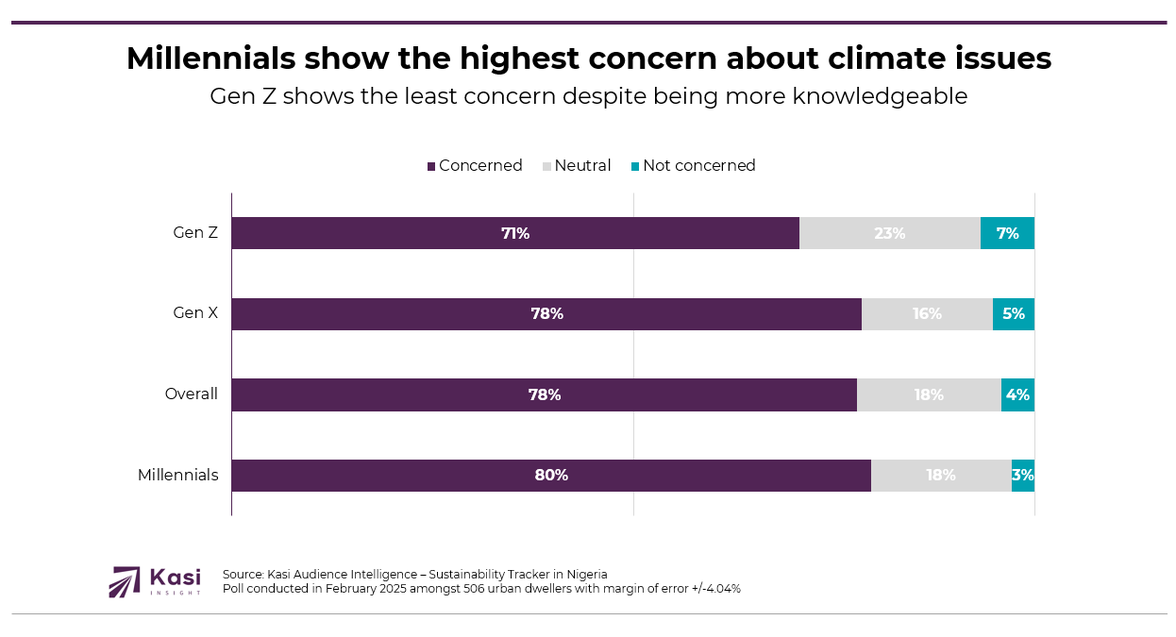
Gen Z, despite being the most informed group, is the least emotionally engaged. Only 71% of Gen Z say they are concerned about climate change. More notably, 23% report feeling neutral about the issue, and 7% say they are not concerned at all. This rate of disinterest is more than double that of Millennials at 3% and notably higher than the 5% recorded among Gen X.
The variation in climate concern across age groups presents a strategic opportunity for brands, educators, and advocacy groups. While awareness of environmental issues is relatively high among Nigerians, the level of emotional concern and willingness to take action differs by generation. Millennials are both knowledgeable and deeply engaged, making them a strong audience for campaigns focused on practical solutions, sustainable living, and climate advocacy. Their combination of awareness and motivation positions them as natural champions for driving behavior change and influencing others.
Gen X represents a balanced and stable segment. They combine moderate levels of knowledge with steady concern, suggesting that they can play an influential role within families and communities. Gen Z is the most complex group to engage. Although they report high levels of awareness, they also display the lowest levels of emotional concern. This split highlights the need for a new approach, one that connects with their identity, emotions, and digital culture.
To make real progress, stakeholders in Nigeria’s climate ecosystem must look beyond generic awareness campaigns. Engagement strategies should reflect the mindset, media habits, and emotional triggers of each generation. True climate action begins when people not only understand the problem but also care deeply enough to act. Bridging the gap between knowing and caring requires more than facts. It demands that the climate crisis be made visible, urgent, and personal across all segments of the population.
Share on socials using this caption: Nigerians know about climate change but do not feel the same urgency 🌍 Millennials lead in concern and action 💪 while Gen Z is aware but disconnected 😶 Brands must move beyond awareness to spark real change 🔥 #ClimateAction #NigeriaYouth #GenZVoices #SustainabilityAfrica #EcoEngagement
1525 views
Share article
The Future of AI in Africa Lies in Smarter Decisions, Not Just Smarter Models
Africa’s Critical Minerals: From Hidden Resource to Economic Catalyst
Perceptions of climate inaction persist among Ghanaian consumers, driven by income disparities