Sandra Beldine Otieno, MSc
April 28, 2025
Share article



Canada votes today in one of the most consequential elections in recent history, with economic anxiety, geopolitical tension, and a leadership transition shaping voter sentiment. This is the first federal election since the resignation of Justin Trudeau, and current Prime Minister Mark Carney, who assumed leadership of the Liberal Party earlier this year, is seeking to hold onto power. He faces strong opposition from Pierre Poilievre of the Conservative Party, Jagmeet Singh of the New Democratic Party, and Yves-François Blanchet of the Bloc Québécois.
While the election campaign has focused on issues such as affordability, taxation, and housing, recent comments by U.S. President Donald Trump have introduced a new level of tension. President Trump has openly questioned Canada’s sovereignty and imposed tariffs on Canadian goods, with the threat of further tariff increases remaining on the table. These actions have reframed the election as a test of leadership stability under pressure from external forces. Although traditional polling shows a tight race, consumer confidence data offers a more nuanced view. The mood of the electorate is cautious but not rebellious, indicating a preference for continuity rather than sweeping political change.
To understand how Canadians are thinking about this election, it’s essential to look beyond popularity polls and consider the broader national mood. Consumer confidence is a reliable indicator of public sentiment toward personal well-being and the direction of the country. This analysis draws from the nationally recognized Index of Consumer Confidence, produced by Ipsos. This index is based on eleven core questions that assess Canadians' views on the current economy, their expectations for the future, personal financial well-being, job security, purchasing confidence, and their ability to save and invest. The responses are then converted into a score ranging from zero to one hundred, with fifty representing a neutral outlook. A score of zero indicates a significant lack of confidence, while a score of one hundred reflects extreme optimism.
These figures were further analyzed using the Kasi Insight Balanced Index methodology, which adjusts the scale to range from –100 to +100, with zero as the midpoint. Positive scores represent optimism, while negative values signal concern or restraint. This methodology has been successfully applied to predict election outcomes in diverse political environments, accurately forecasting results in nine out of ten national elections across countries such as Kenya, Ghana, Nigeria, Senegal, and South Africa. The methodology focuses on two key measures: the average sentiment in the twelve months leading up to the election and the volatility of that sentiment over the same period. Together, these indicators provide valuable insight into whether the public is leaning toward change or reaffirming the status quo.
Between January 2023 and April 2025, Canadian consumer confidence never returned to sustained optimism. Using the Balanced Index scale, the average sentiment score over the past twelve months stood at –3.4. While mildly negative, this figure does not reflect a society in political crisis. In January 2023, confidence was already low at –2.4, and it dropped further to –5.4 in March. A brief rebound occurred in June, climbing to +2.9, but it did not last. By October 2023, sentiment had dropped to –8.9, the lowest point in the entire dataset.
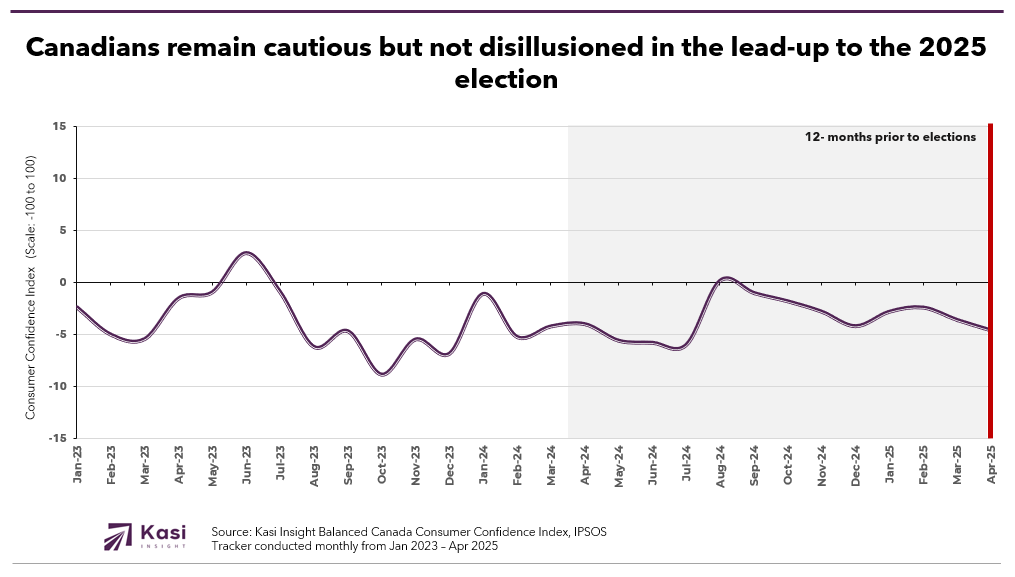
The pattern continued into 2024. Confidence remained below zero throughout the year, reaching –6.0 in July and recovering only slightly to –1.0 in September. In August 2024, the index briefly turned positive at +0.2, but that uptick was short-lived. Sentiment settled back to –2.8 in November, –4.2 in December, and declined further to –4.6 by April 2025. These figures suggest Canadians are uneasy, but not expressing the kind of disillusionment that typically precedes electoral turnover.
In addition to average sentiment, the extent to which confidence has shifted over time offers insight into how engaged the electorate has been. Over the past twelve months, Canadian consumer confidence showed a volatility rate of 57.65%. This reflects a moderate level of public reactivity. Voters have been responsive to developments such as inflation, interest rates, and political leadership, but their emotional swings have remained relatively stable.
A volatility rate at this level does not signal widespread unrest or demand for a political reset. In elections where volatility exceeds 100%, voters are typically more reactive and more likely to drive leadership change. Canada’s pattern suggests that while people are watching closely, they are not emotionally unsettled. They are adjusting expectations without rejecting the current path.
Mark Carney’s leadership has aligned with this sentiment. His emphasis on economic stability and institutional calm resonates with voters who are focused on control rather than confrontation. Pierre Poilievre’s affordability message has energized specific groups, but it has not been accompanied by a sharp national shift in sentiment. Canadians remain cautious but not mobilized for change.
With an average consumer confidence score of –3.4 and a volatility rate of 57.65%, the data reflects a public that is concerned but not demanding disruption. The Liberal Party, under Mark Carney, has responded to economic pressures without proposing sweeping changes, positioning itself as a steady option for voters seeking realistic, gradual progress.
A recent Canada Election Sentiment Survey by Kasi Insight reveals that 55% of Black Canadian voters believe the Liberal Party is most likely to win the upcoming federal election. This aligns with broader trends, where Canadians, overall, appear more inclined to support continuity rather than a major shift in leadership. Despite a strong challenge from the Conservative Party, which garnered 18% of the vote share in the survey, confidence data suggests the public is not seeking to replace the governing party. While Canadians are engaged and cautious, they are not rejecting the current political direction. The most likely outcome of today’s election is a Liberal victory, driven by the prevailing sentiment of continuity rather than upheaval.
Share on socials using this caption: 🇨🇦📊 Canadians are cautious but not unsettled as the 2025 election approaches. Consumer confidence trends suggest a preference for continuity under the Liberals, with a steady outlook driving a likely win. #CanadaElection2025 #ConsumerSentiment #LiberalWin #PoliticalForecast #ElectionPredictions #KasiInsight #LeadershipMatters
1569 views
Share article
The Future of AI in Africa Lies in Smarter Decisions, Not Just Smarter Models
Africa’s Critical Minerals: From Hidden Resource to Economic Catalyst
Perceptions of climate inaction persist among Ghanaian consumers, driven by income disparities