Mercy Cyrus
July 1, 2025
Share article



Kasi Insight's Financial Freedom Tracker conducted annually reveals what financial freedom means to consumers, the products they use and their knowledge on financial products, uncovering patterns that can inform banks, development agencies, and policymakers striving to build economic resilience. In Cameroon, income stagnation and decline since COVID-19 are reshaping aspirations, particularly among skilled and middle-income groups who once felt more secure.
While 41% of Cameroonians say their income has remained unchanged since the pandemic, an even larger share, 46%, report that their earnings have decreased. This trend reflects widespread financial hardship across the country. Significantly, the strain is not confined to low-income households. Among university graduates, 53% have experienced declining incomes, alongside 50% of respondents with low earnings. These groups occupy opposite ends of the labour market spectrum, yet both feel the effects of prolonged economic volatility.
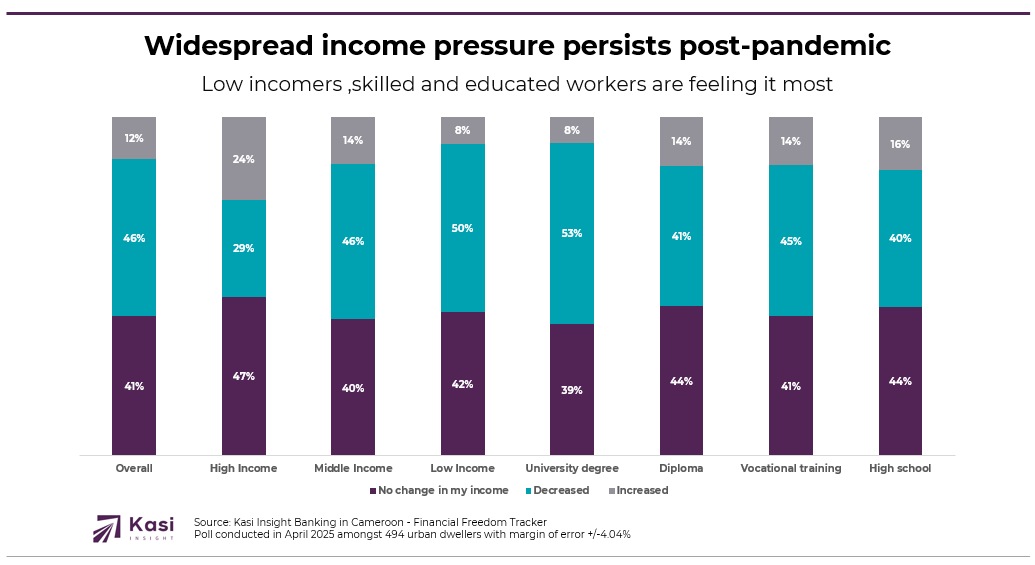
By contrast, higher-income earners have been more shielded from these disruptions. Nearly 47% of affluent respondents report no change in income, and 24% say their earnings have actually improved. This disparity highlights how uneven the recovery has been and underscores the vulnerability of those lacking access to stable or high-paying work.
This prolonged income pressure is prompting many Cameroonians to view migration as a viable path to a more secure future. When asked whether they would move to a different city, region, or country to improve their financial prospects, 64% said yes. The share climbs even higher among middle-income earners (68%) and university graduates (68%), both of whom may feel constrained in their current roles despite their skills and ambitions.
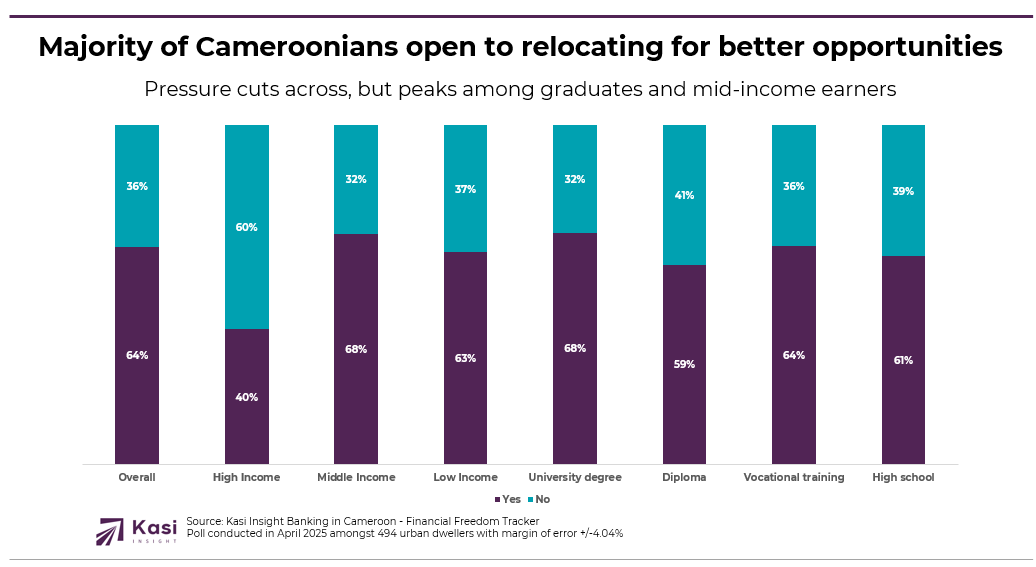
The intention to relocate also extends broadly across other demographics. Among low-income earners, 63% expressed willingness to move, and 61% of respondents with only a high school education are open to relocation. For those with vocational training, the figure rises to 64%. What connects these diverse groups is not only economic dissatisfaction but also a shared conviction that financial freedom requires a fresh start elsewhere.
Rather than seeing this potential migration purely as a drain on the economy, the findings offer a roadmap for targeted, constructive interventions. Migration intent is not random. It is strongest among specific segments middle-income earners, university graduates, and vocationally trained workers, who are motivated as much by hope as by hardship.
For banks with a diaspora focus, this moment presents an opportunity to design products that serve mobile populations. Tailored savings plans, accessible remittance solutions, and investment products that support families back home can help migrants sustain ties to their communities while improving their financial security. These solutions should be easy to adopt, rooted in real consumer behaviour, and adapted to long-term migration patterns.
Development organizations and workforce strategists can step in to strengthen skills and enable reintegration. Entrepreneurship training, remote work opportunities, and cross-border employment programs can all turn mobility into economic momentum rather than a loss of talent. Governments and employers also have a role to play in providing compelling reasons for skilled workers to stay. Investments in job-matching platforms, incentives for talent retention, and regional development initiatives can anchor economic contributors who might otherwise depart. With the right support, today’s prospective migrants can become tomorrow’s engines of local resilience and shared prosperity.
Share on socials using this caption: Cameroonians face rising income pressure 💸 pushing 64% to consider moving for better opportunities 🌱 From tailored banking solutions to smart labor strategies, supporting ambition can turn migration into resilience ✨ #FinancialFreedom #Cameroon
1608 views
Share article
Uganda Banking Sector 2025: Growth with Discipline, What Marketing Signals Reveal About Balance Sheets
Kenya Banking Sector 2025: Reading the Balance Sheet Through Marketing Signals
How Consumer Sentiment Predicts South Africa’s Credit Cycles