Paul Cheloti Mulongo
June 11, 2025
Share article


Kasi Insight's Cost of Living tracker provides crucial insights into the shifting economic landscape across Africa. Conducted quarterly in 20 African markets, the tracker offers a comprehensive analysis of consumer perceptions on rising costs across various sectors and how people are coping with inflationary pressures. In Cameroon, recent data from Q4 2024 to Q1 2025 highlights that while some aspects of daily life have improved, economic pressure is far from over.
When asked how rising prices have impacted different areas of their lives, a major shift is seen in access to healthcare, where the index jumped +27 points from -5 in Q4 2024 to +22 in Q1 2025. This suggests that more households are managing to afford doctor visits, medications, and treatments possibly due to seasonal health patterns or better access to subsidized care. Similarly, the ability to cover daily expenses like food, transport, and airtime improved by 15 points, rising from -29 to -14. While this score is still negative (indicating ongoing struggle), the improvement signals that inflationary pressure may be stabilizing in essential categories.
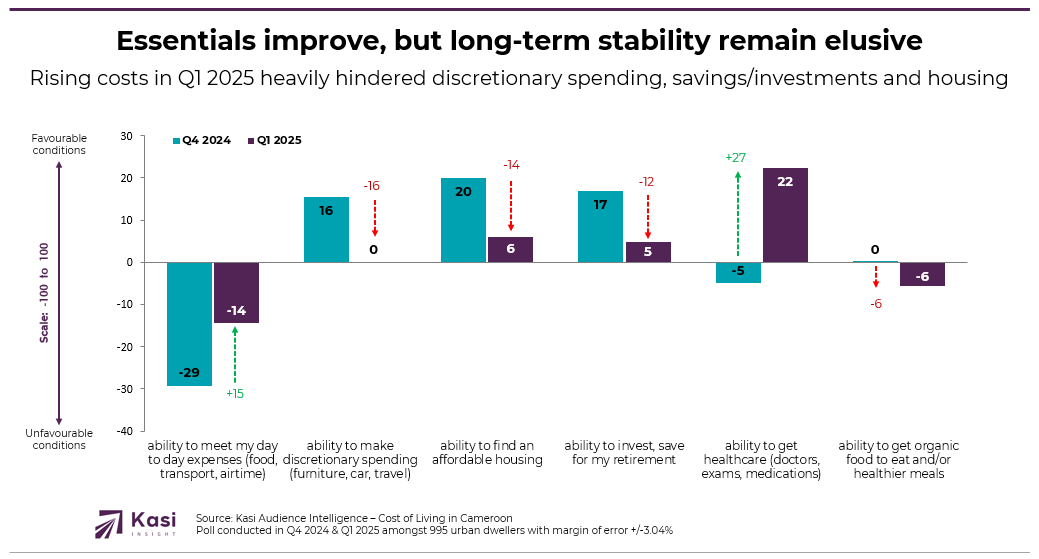
However, the outlook darkens when it comes to future-oriented and aspirational needs. The ability to make discretionary purchases fell from +16 to 0, while the ability to afford housing and save or invest for the future declined by 14 and 12 points, respectively. Worryingly, the ability to access organic food and healthier meals deteriorated from 0 to -6, pointing to a shift toward cheaper, less nutritious diets as inflation eats into food budgets.
Despite mixed shifts in the impact of rising prices, households overwhelmingly resort to borrowing to manage their daily expenses. Data from Q1 2025 shows that nearly 9 in 10 respondents had to borrow. Specifically, 14% borrowed often, and 75% borrowed a few times confirming that borrowing is now a mainstream coping mechanism rather than a last resort.
Breaking down the data by demographic segments reveals further insights. Millennials, Gen X, and Gen Z all reported high levels of borrowing, with 74 - 80% borrowing a few times and 13 - 14% borrowing often. The consistency across these age groups indicates that financial pressure is a shared burden, transcending generational lines.
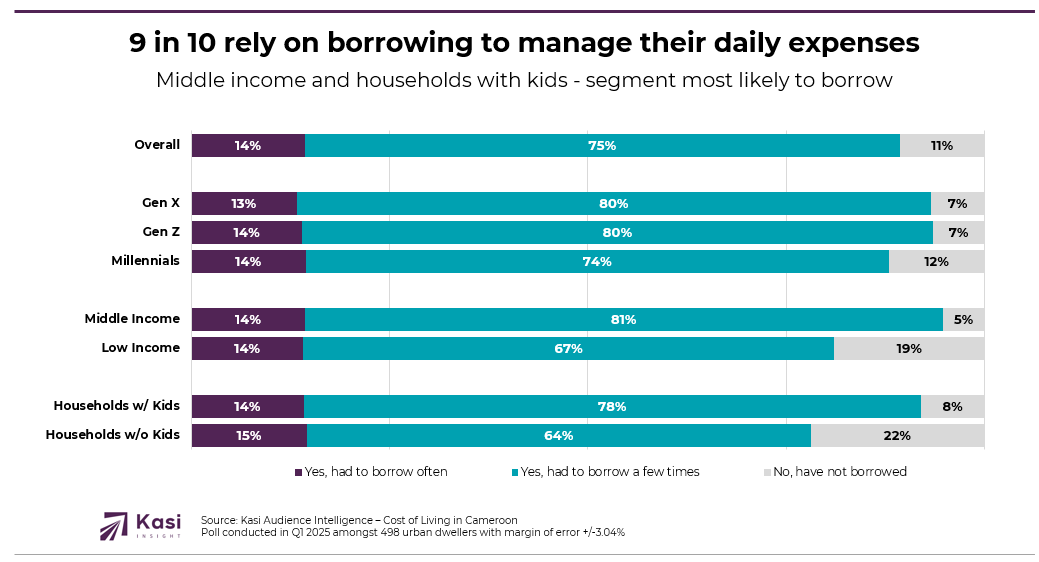
Interestingly, middle-income earners are more likely to borrow than low-income ones. While 81% of low-income respondents said they borrowed either frequently or occasionally, the number jumps to 95% for middle-income earners, with only 5% reporting no borrowing at all. This challenges traditional assumptions that only low-income segments face acute financial strain. Moreover, the data shows that having kids increases financial pressure as over 92% of households with kids reported borrowing, compared to 78% of childless households.
The data reveals both a pressing challenge and a strategic opportunity for businesses operating in Cameroon, particularly financial institutions, consumer goods companies, and telecom providers. As more consumers rely on borrowing to manage essential expenses such as food, healthcare, and transport, affordability is no longer simply a pricing tactic. It has become a fundamental part of the value proposition. Financial service providers should prioritize expanding access to micro-loans, offering flexible repayment plans, and designing products that specifically address the needs of middle-income earners who are increasingly under pressure. At the same time, FMCG brands must rethink their approach to packaging and pricing by introducing smaller pack sizes, family bundles, or value-driven promotions that resonate with households facing economic strain.
There is also a growing concern around access to affordable and nutritious food, as many Cameroonians shift toward lower-cost diets that sacrifice health. Brands that provide healthier yet budget-friendly options have an opportunity to stand out in a saturated market. Additionally, with digital finance becoming an essential part of daily survival, there is space to innovate through mobile wallets, pay-later models, and retailer-financier partnerships that help consumers better manage limited cash flow. Companies that succeed in 2025 will be those that embed empathy into their operations by aligning with the lived realities of ordinary Cameroonians. This not only fosters long-term brand loyalty but also drives meaningful and inclusive business growth.
Share on socials using this caption: 📉 In Cameroon, borrowing is no longer a backup plan but a lifeline. Nearly 9 in 10 people rely on it to survive rising costs, even among the middle class. 💡🇨🇲 #Cameroon #ConsumerTrends #CostOfLiving #BorrowingCrisis #KasiInsight #Inflation #DataDrivenGrowth
1273 views
Share article
Trust Is Becoming Economic Infrastructure
Consumer confidence loses momentum in October
Confidence plateaus in September as caution defines household behavior